Allocating assets to only one or a small number of the investment options (other than the Target Date ‘Lifecycle’ or Target Risk ‘Lifestyle’ options) should not be considered a balanced investment program. In particular, allocating assets to a small number of options concentrated in particular business or market sectors will subject your account to increased risk and volatility. Examples of business or market sectors where this risk may be particularly high include: a) technology-related businesses, including Internet-related businesses, b) small-cap securities and c) foreign securities. John Hancock does not provide advice regarding appropriate investment allocations.
Restricted/Illiquid Securities Restricted and illiquid securities may fall in price because of an inability to sell the securities when desired. Investing in restricted securities may subject the portfolio to higher costs and liquidity risk.
Underlying Fund/Fund of Funds A portfolio’s risks are closely associated with the risks of the securities and other investments held by the underlying or subsidiary funds, and the ability of the portfolio to meet its investment objective likewise depends on the ability of the underlying funds to meet their objectives. Investment in other funds may subject the portfolio to higher costs than owning the underlying securities directly because of their management fees.
Credit Default Swaps Credit default swaps insure the buyer in the event of a default of a fixed-income security. The seller of a credit default swap receives premiums and is obligated to repay the buyer in the event of a default of the underlying creditor. Investments in credit default swaps may be subject to increased counterparty, credit, and liquidity risks.
Dollar Rolls Dollar rolls transactions may be subject to the risk that the market value of securities sold to the counterparty declines below the repurchase price, the counterparty defaults on its obligations, or the portfolio turnover rate increases because of these transactions. In addition, any investments purchased with the proceeds of a security sold in a dollar rolls transaction may lose value.
Real Estate/REIT Sector Concentrating assets in the real estate sector or REITs may disproportionately subject the portfolio to the risks of that industry, including loss of value because of changes in real estate values, interest rates, and taxes, as well as changes in zoning, building, environmental, and other laws, among other factors. Investments in REITs may be subject to increased price volatility and liquidity risk, and shareholders indirectly bear their proportionate share of expenses because of their management fees.
Structured Products Investments in structured products may be more volatile, less liquid, and more difficult to price than other assets. These securities bear the risk of the underlying investment as well as counterparty risk. Securitized structured products including CMOs, CDOs, and other securitized products may increase volatility and be subject to increased liquidity and pricing risks compared with investing directly in the assets securitized within the product. Assets invested in structured products may be subject to full loss of value if the counterparty defaults on its obligation.
Loss of Money Because the investment’s market value may fluctuate up and down, an investor may lose money, including part of the principal, when he or she buys or sells the investment.
U.S. Government Obligations Investments in U.S. government obligations are subject to varying levels of government support. In the event of default, some U.S. government securities, including U.S. Treasury obligations and Ginnie Mae securities, are issued and guaranteed as to principal and interest by the full faith and credit of the U.S. government. Other securities are obligations of U.S. government-sponsored entities but are neither issued nor guaranteed by the U.S. government.
Reliance on Trading Partners Investments in economies that depend heavily on trading with key partners may be subject to the risk that any reduction in this trading may adversely impact these economies.
Custody Foreign custodial and other foreign financial services are generally more expensive than they are in the United States and may have limited regulatory oversight. The investment may have trouble clearing and settling trades in less-developed markets, and the laws of some countries may limit the investment’s ability to recover its assets in the event the bank, depository, or agent holding those assets goes into bankruptcy.
Index Correlation/Tracking Error A portfolio that tracks an index is subject to the risk that certain factors may cause the portfolio to track its target index less closely, including if the advisor selects securities that are not fully representative of the index. The portfolio will generally reflect the performance of its target index even if the index does not perform well, and it may underperform the index after factoring in fees, expenses, transaction costs, and the size and timing of shareholder purchases and redemptions.
Unrated Securities Investments in unrated securities may be subject to increased interest, credit, and liquidity risks if the advisor does not accurately assess the quality of those securities.
Conflict of Interest A conflict of interest may arise if the advisor makes an investment in certain underlying funds based on the fact that those funds are also managed by the advisor or an affiliate or because certain underlying funds may pay higher fees to the advisor do than others. In addition, an advisor’s participation in the primary or secondary market for loans may be deemed a conflict of interest and limit the ability of the investment to acquire those assets.
Equity Securities The value of equity securities, which include common, preferred, and convertible preferred stocks, will fluctuate based on changes in their issuers’ financial conditions, as well as overall market and economic conditions, and can decline in the event of deteriorating issuer, market, or economic conditions.
Futures Investments in futures contracts and options on futures contracts may increase volatility and be subject to additional market, active management, interest, currency, and other risks if the contract cannot be closed when desired.
Derivatives Investments in derivatives may be subject to the risk that the advisor does not correctly predict the movement of the underlying security, interest rate, market index, or other financial asset, or that the value of the derivative does not correlate perfectly with either the overall market or the underlying asset from which the derivative's value is derived. Because derivatives usually involve a small investment relative to the magnitude of liquidity and other risks assumed, the resulting gain or loss from the transaction will be disproportionately magnified. These investments may result in a loss if the counterparty to the transaction does not perform as promised.
Fixed-Income Securities The value of fixed-income or debt securities may be susceptible to general movements in the bond market and are subject to interest-rate and credit risk.
Passive Management The investment is not actively managed, and the advisor does not attempt to manage volatility or take defensive positions in declining markets. This passive management strategy may subject the investment to greater losses during general market declines than actively managed investments.
High-Yield Securities Investments in below-investment-grade debt securities and unrated securities of similar credit quality, commonly known as "junk bonds" or "high-yield securities," may be subject to increased interest, credit, and liquidity risks.
Country or Region Investments in securities from a particular country or region may be subject to the risk of adverse social, political, regulatory, or economic events occurring in that country or region. Country- or region-specific risks also include the risk that adverse securities markets or exchange rates may impact the value of securities from those areas.
Risk of Increase in Expenses for Sub-Account. Your actual costs of investing in the fund may be higher than the expenses shown in "Annual fund operating expenses" for a variety of reasons. For example, expense ratios may be higher than those shown if a fee limitation is changed or terminated or if average net assets decrease. Net assets are more likely to decrease and fund expense ratios are more likely to increase when markets are volatile.
Merger and Replacement Transition Risk for Sub-Account. It is possible that the Fund will be replaced with or merged into another investment option offered under your plan's group annuity contract. In the case of fund mergers and replacements, the affected funds that are being merged or replaced may implement the redemption of your interest by payment in cash or by distributing assets in kind. In either case, the redemption of your interest by the affected fund, as well as the investment of the redemption proceeds by the ''new'' fund, may result in transaction costs to the funds because the affected funds may find it necessary to sell securities and the ''new'' funds will find it necessary to invest the redemption proceeds. Also, the redemption and reinvestment processes, including any transition period that may be involved in completing such mergers and replacements, could be subject to market gains or losses, including those from currency exchange rates. The transaction costs and potential market gains or losses could have an impact on the value of your investment in the affected fund and in the ''new'' fund, and such market gains or losses could also have an impact on the value of any existing investment that you or other investors may have in the ''new'' fund. Although there can be no assurances that all risks can be eliminated, the portfolio manager(s) of the affected funds will use their best efforts to manage and minimize such risks and costs.
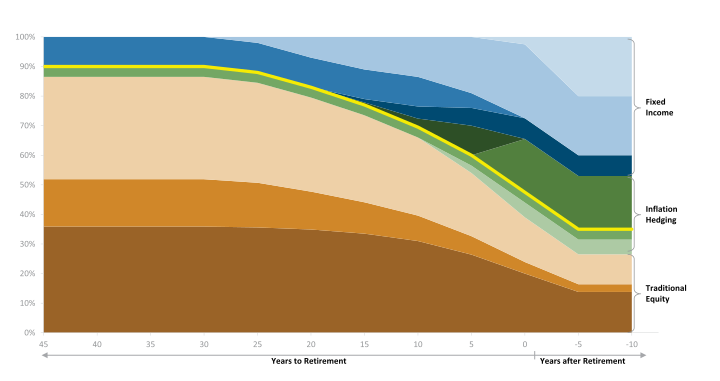
Target Date Portfolio Risk. A Target Date Portfolio is an investment option comprised of ''fund of funds'' which allocate their investments among multiple asset classes which can include U.S. and foreign equity and fixed income securities. The ''target date'' in a target date portfolio is the approximate date an investor plans to start withdrawing money. The Portfolio’s ability to achieve its investment objective will depend largely on the ability of the sub-adviser to select the appropriate mix of underlying funds and on the underlying funds’ ability to meet their investment objectives. The portfolio managers control security selection and asset allocation. There can be no assurance that either a Fund or the underlying funds will achieve their investment objectives. An investor should examine the asset allocation of the fund to ensure it is consistent with their own risk tolerance.
A Fund is subject to the same risks as the underlying funds in which it invests. Because target date funds are managed to specific retirement dates, investors may be taking on greater risk if the actual year of retirement differs dramatically from the original estimated date. Target date funds generally shift to a more conservative investment mix over time. While this may help to manage risk, it does not guarantee earnings growth nor is the fund's principal value guaranteed at any time including at the target date. An investment in a target-date fund is not guaranteed, and you may experience losses, including losses near, at, or after the target date. There is no guarantee that the fund will provide adequate income at and through retirement. Consider the investment objectives, risks, charges, and expenses of the fund carefully before investing.
For a more complete description of these and other risks, please review the fund’s prospectus.
Inflation-Protected Securities Unlike other fixed-income securities, the values of inflation-protected securities are not significantly impacted by inflation expectations because their interest rates are adjusted for inflation. Generally, the value of inflation-protected securities will fall when real interest rates rise and rise when real interest rates fall.
Commodity Investments in commodity-related instruments are subject to the risk that the performance of the overall commodities market declines and that weather, disease, political, tax, and other regulatory developments adversely impact the value of commodities, which may result in a loss of principal and interest. Commodity-linked investments face increased price volatility and liquidity, credit, and issuer risks compared with their underlying measures.
Currency Investments in securities traded in foreign currencies or more directly in foreign currencies are subject to the risk that the foreign currency will decline in value relative to the U.S. dollar, which may reduce the value of the portfolio. Investments in currency hedging positions are subject to the risk that the value of the U.S. dollar will decline relative to the currency being hedged, which may result in a loss of money on the investment as well as the position designed to act as a hedge. Cross-currency hedging strategies and active currency positions may increase currency risk because actual currency exposure may be substantially different from that suggested by the portfolio’s holdings.
Swaps Investments in swaps, such as interest-rate swaps, currency swaps and total return swaps, may increase volatility and be subject to increased liquidity, credit, and counterparty risks. Depending on their structure, swaps may increase or decrease the portfolio’s exposure to long- or short-term interest rates, foreign currency values, corporate borrowing rates, security prices, index values, inflation rates, credit, or other factors.
Other The investment’s performance may be impacted by its concentration in a certain type of security, adherence to a particular investing strategy, or a unique aspect of its structure and costs.
Sampling Although the portfolio tracks an index, it maintains a smaller number of holdings than does the index. Use of this representative sampling approach may lead the portfolio to track the index less closely.
Management Performance is subject to the risk that the advisor’s asset allocation and investment strategies do not perform as expected, which may cause the portfolio to underperform its benchmark, other investments with similar objectives, or the market in general. The investment is subject to the risk of loss of income and capital invested, and the advisor does not guarantee its value, performance, or any particular rate of return.
Hedging Strategies The advisor’s use of hedging strategies to reduce risk may limit the opportunity for gains compared with unhedged investments, and there is no guarantee that hedges will actually reduce risk.
Interest Rate Most securities are subject to the risk that changes in interest rates will reduce their market value.
Replication Management The investment does not seek investment returns in excess of the underlying index. Therefore, it will not generally sell a security unless it was removed from the index, even if the security’s issuer is in financial trouble.
Convertible Securities Investments in convertible securities may be subject to increased interest-rate risks, rising in value as interest rates decline and falling in value when interest rates rise, in addition to their market value depending on the performance of the common stock of the issuer. Convertible securities, which are typically unrated or rated lower than other debt obligations, are secondary to debt obligations in order of priority during a liquidation in the event the issuer defaults.
Forwards Investments in forwards may increase volatility and be subject to additional market, active management, currency, and counterparty risks as well as liquidity risk if the contract cannot be closed when desired. Forwards purchased on a when-issued or delayed-delivery basis may be subject to risk of loss if they decline in value prior to delivery, or if the counterparty defaults on its obligation.
Quantitative Investing Holdings selected by quantitative analysis may perform differently from the market as a whole based on the factors used in the analysis, the weighting of each factor, and how the factors have changed over time.
Industry and Sector Investing Concentrating assets in a particular industry, sector of the economy, or markets may increase volatility because the investment will be more susceptible to the impact of market, economic, regulatory, and other factors affecting that industry or sector compared with a more broadly diversified asset allocation.
Small Cap Concentrating assets in small-capitalization stocks may subject the portfolio to the risk that those stocks underperform other capitalizations or the market as a whole. Smaller, less-seasoned companies may be subject to increased liquidity risk compared with mid- and large-cap companies and may experience greater price volatility than do those securities because of limited product lines, management experience, market share, or financial resources, among other factors.
Reinvestment Payments from debt securities may have to be reinvested in securities with lower interest rates than the original securities.
Foreign Securities Investments in foreign securities may be subject to increased volatility as the value of these securities can change more rapidly and extremely than can the value of U.S. securities. Foreign securities are subject to increased issuer risk because foreign issuers may not experience the same degree of regulation as U.S. issuers do and are held to different reporting, accounting, and auditing standards. In addition, foreign securities are subject to increased costs because there are generally higher commission rates on transactions, transfer taxes, higher custodial costs, and the potential for foreign tax charges on dividend and interest payments. Many foreign markets are relatively small, and securities issued in less-developed countries face the risks of nationalization, expropriation or confiscatory taxation, and adverse changes in investment or exchange control regulations, including suspension of the ability to transfer currency from a country. Economic, political, social, or diplomatic developments can also negatively impact performance.
Market/Market Volatility The market value of the portfolio’s securities may fall rapidly or unpredictably because of changing economic, political, or market conditions, which may reduce the value of the portfolio.
Warrants Investments in warrants may be subject to the risk that the price of the underlying stock does not rise above the exercise price. In this event, the warrant may expire without being exercised and lose all value.
Emerging Markets Investments in emerging- and frontier-markets securities may be subject to greater market, credit, currency, liquidity, legal, political, and other risks compared with assets invested in developed foreign countries.
Target Date Target-date funds, also known as lifecycle funds, shift their asset allocation to become increasingly conservative as the target retirement year approaches. Still, investment in target-date funds may lose value near, at, or after the target retirement date, and there is no guarantee they will provide adequate income at retirement.
Mid-Cap Concentrating assets in mid-capitalization stocks may subject the portfolio to the risk that those stocks underperform other capitalizations or the market as a whole. Mid-cap companies may be subject to increased liquidity risk compared with large-cap companies and may experience greater price volatility than do those securities because of more-limited product lines or financial resources, among other factors.